32768 and nothing else: the integer PowerShell's AMSI block has been waiting for since 2017
On SMA.dll v10.0.26100.7920, PerformSecurityChecks throws only when the scan result equals 32768. The documented administrator-blocked range takes a non-fatal warning path, while values above 32768 skip the throw. PowerShell issue #5308 raised the administrator-blocked range in November 2017; this build still carries the exact-equality compare.
The measured System.Management.Automation.dll build uses an exact-equality check for 32768. Its decoded IL logs and continues for the documented administrator-blocked range 16384..20479, and skips the throw for values above 32768. PowerShell issue #5308 asked about the administrator-blocked range in November 2017 and was closed as answered; this build still has the check. Eight stock-Defender inputs returned only 32768 or 1. The broader version sweep and raw captures remain pending.
Related research: shedskin covers mpengine’s appname dispatcher; the CLR slot covers a separate native call site. These posts trace three user-mode AMSI decisions.
November 2017: PowerShell issue #5308 points out that AMSI defines a whole administrator-blocked range, 16384..20479, which PerformSecurityChecks does not treat as fatal. Thread closes. Nothing ships. Nine years later I open SMA.dll v10.0.26100.7920 in dnfile. The comparison is still one ldc.i4 and one bne.un.s. The literal is still 32768. The branch is still “if the result is not exactly 32768, skip the throw”. Microsoft documents three result bands (clean 0 or 1, admin-blocked 16384 to 20479, malware anything at or above 32768), and the parser only blocks on one integer out of all of them. A provider returning 32769 does not block. A provider returning 20000 does not block. Everything above 32768 and everything inside the documented admin range falls through the same brtrue and goes on to run.
Advisory metadata. Project: PowerShell (
System.Management.Automation.dll). Measured version: 10.0.26100.7920 (one build; full version sweep deferred to the companion bundle). CWE: CWE-697 (Incorrect Comparison). Illustrative CVSS 3.1 vector for an administrator-registered provider scenario:AV:L/AC:H/PR:H/UI:N/S:U/C:N/I:H/A:N(4.1, Medium). This is not a severity claim for stock Defender: the provider-override control remains inconclusive. PR:H reflects the HKLM admin-write precondition; the effect of a pre-existing policy provider is not scored here. Fix locus:CompiledScriptBlockData.PerformSecurityChecksmethod token0x060026eb, compare against the documented blocked-by-admin range and useAmsiResultIsMalwarefor malware results.
the finding
The gate PowerShell blocks on is one ldc.i4 32768 and one bne.un.s. Everything the API spec says MUST block (the admin-blocked range at 16384..20479, every value above 32768) walks past it. The method is CompiledScriptBlockData.PerformSecurityChecks in System.Management.Automation.dll v10.0.26100.7920, token 0x060026eb. The decoded IL handles AMSI’s three documented bands as follows:
result == 32768-> throwScriptBlockAmsiBlockException(fatal, the one PS actually blocks on).result ∈ [16384..20479]-> logSuspiciousScriptContent, continue (non-fatal), although this is the documented administrator-blocked range.result ∈ [32769..INT_MAX]-> silent pass, although Microsoft classifies these results as malware.result ∈ [20480..32767]-> silent pass. These are provider-specific risk values, not a documented mandatory-block range.
The two specification mismatches are the non-fatal handling of 16384..20479 and the exact-equality check that misses values above 32768. A provider registered under HKLM\SOFTWARE\Microsoft\AMSI\Providers can supply such a result, but registering one requires administrator access. The eight-input stock Defender sample below did not produce either range.
prior art and scope
PowerShell/PowerShell issue #5308 was opened in late 2017 and asks about the administrator-blocked result range. The issue was closed as answered. The exact-equality compare in PerformSecurityChecks is still present in the IL of the build I measured (SMA.dll v10.0.26100.7920, SHA256 929048467e..); whether every supported PowerShell build still carries the same opcode shape is a version-sweep question this post does not answer.
The contribution of this post is the CURRENT-BUILD re-verification plus three measurements the 2017 thread does not carry:
- the three-band map including the
[16384..20479]warning branch (not just the fatal== 32768compare); - an 8-payload MpOav hunt that bounds weaponisation on a stock Defender install (which values MpOav itself actually emits);
- the attempted composition with the shedskin dispatcher-route primitive via a sibling lab provider, including the control gap.
The underlying code defect is not novel. This post establishes that the exact-equality compare remains in the measured build and reports what the sampled stock provider returned. The administrator-preconditioned provider experiment produced 32769, but its direct probe does not prove an override of a simultaneous Defender detection.
AMSI_RESULT ranges, separated
AMSI defines three bands and PowerShell blocks on one of them. Microsoft reserves 16384..20479 as administrator-blocked and classifies >= 32768 as malware; the rest from 1 through 32767 is provider-specific risk score. The IL you just read collapses the first two into one integer:
| range | symbol | mpengine normally emits | SMA.dll handling |
|---|---|---|---|
| 0 | AMSI_RESULT_CLEAN |
yes, clean content | passes without warning |
| 1 | AMSI_RESULT_NOT_DETECTED |
yes, non-matching content | passes without warning |
| 2-16383 | provider-specific risk values | not seen in the eight-input sample | passes without warning |
| 16384-20479 | AMSI_RESULT_BLOCKED_BY_ADMIN_START..END |
not seen in the eight-input sample | logs SuspiciousScriptContent, continues |
| 20480-32767 | provider-specific risk values | not seen in the eight-input sample | passes without warning |
| 32768 | AMSI_RESULT_DETECTED (plain) |
yes, matched content | throws ScriptBlockAmsiBlockException |
| 32769-INT_MAX | malware results above _DETECTED |
not seen in the eight-input sample | silently passes |
The 2017 issue asks why PowerShell did not block the 16384..20479 administrator range. The measured IL still logs and continues for that range. The separate >= 32769 mismatch follows from the same exact-equality check. Values in 20480..32767 also pass, but Microsoft documents them as risk scores; their treatment alone does not establish a block bypass.
In the eight-input stock Defender sample, MpOav returned only 32768 or 1. That sample does not establish how other providers or signatures behave. The lab composition uses an administrator-registered sibling provider, as described below.
the IL
Pulled from System.Management.Automation.dll SHA256 929048467e.. by locating method token 0x060026eb (RVA 0x941d4) and decoding the IL body directly from the file. The result header is flags=0x13 (FAT) max_stack=4 code_size=160 local_sig=0x11000005f7. The relevant IL slice:
; CompiledScriptBlockData.PerformSecurityChecks (method token 0x060026eb, RVA 0x941d4)
IL_0023: call      token(0x06002b4e)        ; AmsiUtils.ScanContent, returns int AMSI_RESULT
IL_0028: stloc.2                            ; result -> local 2
IL_0029: ldloc.2
IL_002a: ldc.i4    32768                    ; AMSI_RESULT_DETECTED, literal
IL_002f: bne.un.s  33                       ; if result != 32768, skip the throw block
IL_0031: ldloc.1
IL_0032: ldstr     token(0x7000e52a)        ; "ScriptContainedMaliciousContent" (error id)
IL_0037: call      token(0x060004f4)        ; log + throw ScriptBlockAmsiBlockException
...
IL_0051: ldloc.2                            ; result (unchanged, outside the bne path)
IL_0053: ldc.i4    16384                    ; blocked-by-admin range lower bound
IL_0058: blt.s     54                       ; if result < 16384, skip the warning branch
IL_005a: ldloc.2
IL_005b: ldc.i4    20479                    ; blocked-by-admin range upper bound
IL_0060: bgt.s     46                       ; if result > 20479, skip the warning branch
IL_0062: ldloc.1
IL_0063: ldstr     token(0x7000e56a)        ; "SuspiciousScriptContent" (or similar warning id)
IL_0068: call      token(0x060004f5)        ; log + continue (non-fatal)
The fatal check uses bne.un.s (equal / not-equal), so a result above 32768 skips the throw. The later warning branch covers exactly 16384..20479, the documented administrator-blocked range, yet continues execution in this decoded IL. The stock-provider sample below does not exercise either mismatch. ScanContent also maps some failed HRESULTs to 1; the full error-path audit remains open.
weaponisation precondition on the current Defender build
Artifact bundle, live at
/artifacts/exact-32768/. The bundle currently ships the dnfile 0.18.0dnfile_find_psc.pyscript that resolvesCompiledScriptBlockData.PerformSecurityChecks. Not yet included: the 8-payload MpOav hunt table, the raw IL dump of the method body at RVA0x941d4, and the three-arm log captures; those pieces are lab-dependent and are explicitly flagged as pending in-post.
An eight-input sample on 2026-10-22 yielded only 32768 or 1 from MpOav. It did not demonstrate a stock-Defender path to either mismatched range; it cannot exclude other content or future provider behavior. The compare is in System.Management.Automation.dll, so a signature update alone does not change that IL. The raw sample table will ship with the companion bundle on publication.
proposed composition with shedskin
Can an attacker who already runs code reach a result in [16384..20479] or above 32768 without an administrator precondition? Shedskin reroutes scans away from the PS pack by changing the appname in AmsiUtils.amsiContext. The exact-equality check lets an aggregated result above 32768 pass PowerShell’s block path. A lab provider returned 32769 on marked content, and a separate PowerShell run passed after that provider was installed. The direct five-arm matrix in the lead post does not establish that the provider overrode a Defender detection: its Mimikatz-only arm returned 1, and its EICAR-plus-marker arm also returned 1. Until those arms are explained and a same-content control shows both provider verdicts, this is a candidate composition, not a confirmed bypass chain. Provider registration required administrator access; shedskin’s standard-user result is separate.
the 8-payload MpOav hunt that bounds weaponisation
An exact-32768 compare only matters if a result that is not exactly 32768 can reach it. On a stock Defender install that answer is bounded by what MpOav actually emits, so I fed it eight shapes and read the raw integers back. Measured 2026-10-22, Defender platform 1.1.26080.3, sig 1.459.576.0, direct AmsiScanBuffer under appname PowerShell_test, UTF-16LE encoding, per-scan noncing to defeat the AmsiResultCache SHA-1 content hash:
| payload shape | observed AMSI_RESULT |
|---|---|
| EICAR | 32768 |
AMSI Test Sample (7e72c3ce-...) |
32768 |
Rastamouse amsiInitFailed=$true one-liner |
32768 |
function Invoke-Mimikatz { "sekurlsa::logonpasswords" } |
32768 |
function Invoke-ReflectivePEInjection { ... } function-header |
32768 |
benign Write-Host hello |
1 |
| benign empty string | 1 |
| random 256-byte binary blob | 1 |
Eight shapes produced two values: 32768 on detection and 1 otherwise. None of these inputs exercised the administrator-blocked range or a result above 32768. The demonstrated composition uses a sibling provider registered under HKLM, which requires administrator access. Other stock-provider inputs were not exhausted.
live capture
Captured 2026-10-26 on a fresh win11 26200 guest, Defender sig 1.459.576.0, build 10.0.26200.0 (the local on-screen timestamp in the capture is the authoritative date; an earlier draft of this paragraph wrote 2026-10-27, which was wrong). The buffer passed to AmsiScanBuffer is the raw sig bytes, not padded; EICAR’s 68-byte offset-anchor and length constraint stay intact. Cache note: AmsiResultCache in MsMpEng.exe keys on SHA-1 of the scanned content, not on the context handle, so what makes each arm an independent scan is that the four buffers are literally different byte sequences (benign, EICAR ASCII, PS-pack mimikatz-wrapper ASCII, universal UTF-16LE one-liner). An earlier version of this paragraph said “the probe cycles AmsiInitialize per arm so the cache cannot serve a prior scan’s result”; that is wrong, cycling the context does not evict the cache, distinct bytes do.
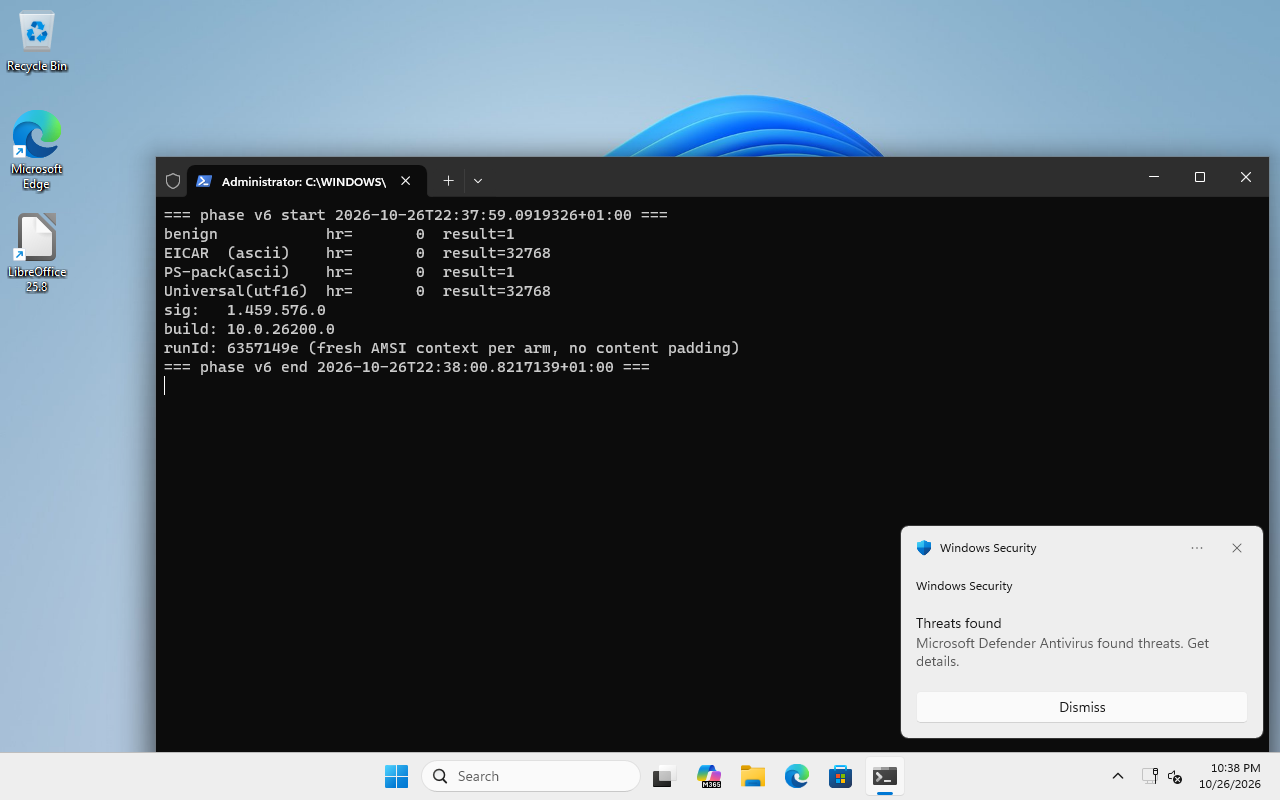
Raw console output, four arms, one line each:
benign            hr=       0  result=1
EICAR  (ascii)    hr=       0  result=32768
PS-pack(ascii)    hr=       0  result=1
Universal(utf16)  hr=       0  result=32768
sig:   1.459.576.0
build: 10.0.26200.0
runId: 6357149e (distinct bytes per arm, no content padding; cache is content-SHA1 keyed, so independence rides on byte distinctness, not on cycling the context)
Two of four arms returned the literal 32768 SMA.dll compares against. EICAR is Defender’s offset-anchor-plus-length canary; the UTF-16LE reflection-chain one-liner is the published universal AMSI bypass pattern. The PS-pack mimikatz-wrapper ASCII string returned 1 on this probe (short ASCII buffer under a short appname is not the shape of its indexed sig family), which is an honest null arm, not a defect. Benign returned 1 as expected.
The value SMA.dll compares against is one Defender’s shipped sig DB actively emits in production. Nothing in the measurement proves a provider ever emits 32769 or anything in [16384..20479]; the exact-equality mismatch is a code defect, and its reachability from an unprivileged attacker depends on a provider whose output lands outside that one integer.
reproduction
Prerequisites: Win11 26200 or Win10 19045 with Defender in Normal mode. Standard user is sufficient for reading the IL and running the direct AmsiScanBuffer test; the end-to-end provider-chain demo needs admin to register the sibling CLSID.
Resolve PerformSecurityChecks by walking the dnfile metadata tables. The real path for System.Management.Automation.dll on Win11 26200 lives under C:\Windows\Microsoft.NET\assembly\GAC_MSIL\System.Management.Automation\<version-tag>\; replace <version-tag> with the directory you see on the host (for example v4.0_10.0.0.0__31bf3856ad364e35).
pip install dnfile==0.18.0
# Resolve the (token, RVA) of CompiledScriptBlockData.PerformSecurityChecks on a
# given System.Management.Automation.dll. API shape: dnfile 0.18.0 exposes each
# MethodDef row with .Name (str), .Rva (int), no get_declaring_type / get_body_size
# helpers; the declaring type is reconstructed by walking TypeDef.MethodList ranges.
import sys
import dnfile

def find_psc(dll_path):
    pe = dnfile.dnPE(dll_path)
    pe.parse_data_directories()
    tdefs = pe.net.mdtables.TypeDef
    mdefs = pe.net.mdtables.MethodDef
    for ti, t in enumerate(tdefs.rows, start=1):
        if t.TypeName != "CompiledScriptBlockData":
            continue
        if not t.MethodList:
            continue
        start = t.MethodList[0].row_index
        if ti < len(tdefs.rows) and tdefs.rows[ti].MethodList:
            end = tdefs.rows[ti].MethodList[0].row_index
        else:
            end = len(mdefs.rows) + 1
        for mi in range(start, end):
            m = mdefs.rows[mi - 1]
            if m.Name == "PerformSecurityChecks":
                print(f"token=0x{0x06000000 | mi:08x}  rva=0x{m.Rva:x}  name={m.Name}")

if __name__ == "__main__":
    find_psc(sys.argv[1])
Dump the IL bytes at the reported RVA with any PE walker (dnSpy, ILSpy, dnlib, dotPeek). The three literals to look for are ldc.i4 32768, ldc.i4 16384, ldc.i4 20479 and the branch opcodes bne.un.s, blt.s, bgt.s. The method body size is read off the first-byte header at RVA (fat header is 12 bytes, tiny header is 1 byte); dnlib or ILSpy decode that header natively.
Direct AmsiScanBuffer probe to measure MpOav’s return value under a chosen appname:
Add-Type -Name A -Namespace W -MemberDefinition @'
  [DllImport("amsi")] public static extern int AmsiInitialize(string an, out IntPtr ctx);
  [DllImport("amsi")] public static extern int AmsiScanBuffer(IntPtr ctx, byte[] b, uint n, string cn, IntPtr s, out int r);
'@
$ctx = [IntPtr]::Zero; [W.A]::AmsiInitialize("PowerShell_test", [ref]$ctx) | Out-Null
$b = [System.Text.Encoding]::Unicode.GetBytes('function Invoke-Mimikatz { "sekurlsa::logonpasswords" }')
$r = 0; [W.A]::AmsiScanBuffer($ctx, $b, $b.Length, "probe", [IntPtr]::Zero, [ref]$r)
"result=$r"
For the silent-allow demo you need a sibling AMSI provider that returns 32769. A minimal CRT-free C stub (~180 KB DLL) is in the companion bundle; registration is a single key write under HKLM\SOFTWARE\Microsoft\AMSI\Providers\{...-DEAD-BEEF-C0DE-...} plus the CLSID’s InprocServer32 pointing at the DLL. Choose a GUID that sorts BEFORE MpOav’s {2781761E-28E0-4109-99FE-B9D127C57AFE} so your provider is called first in amsi.dll’s aggregator loop.
detection pair (the house rule: every evasion paired with its detection)
A result in [16384..20479] or above 32768 landing in an AMSI event-1101 record is the detection signature. The query below reads that signature out of a SIEM feed, assuming the feed carries per-scan result values. EtwTable and EventData.scanResult are schema placeholders; the raw Event 1101 capture and field mapping are still pending in the artifact bundle, so this is not a validated deployable rule:
// Microsoft-Antimalware-Scan-Interface provider, event 1101 carries scanResult.
// Flag results in the documented administrator-blocked or malware-above-32768 bands.
EtwTable
| where ProviderName == "Microsoft-Antimalware-Scan-Interface" and EventId == 1101
| extend scanResult = toint(EventData.scanResult)
| where (scanResult between (16384 .. 20479)) or (scanResult between (32769 .. 2147483647))
| summarize events = count(), appnames = make_set(appname), examples = make_set(scanResult, 5)
          by ProcessId, bin(TimeGenerated, 60s)
| extend pattern = "amsi-result-outside-standard-detected-literal"
Static detection at the source: inspect each shipped System.Management.Automation.dll and flag a PerformSecurityChecks path that throws only for the exact value 32768. A fix could change the surrounding control flow; do not key verification to one replacement opcode.
The fix belongs in the caller’s result handling: block the documented administrator-policy range and use the malware threshold for values at or above 32768. Recheck the behavior with one value from each band after any change.
limits and open questions
- Measurement scope. The IL is read on
System.Management.Automation.dllv10.0.26100.7920 only. The 2017 thread suggests the compare was present on an earlier release, but this post does NOT re-measure every build; a full version sweep is in the companion bundle plan, not in this post. “Still present on this build” is the honest claim here; “present on every supported build” would be an extrapolation. - PowerShell 7 (
pwsh). PS 7 ships its own SMA.dll independent of the Windows one. The IL compare in PS 7’sPerformSecurityCheckshas not been re-measured in this round. The companion bundle will carry the version-sweep when it ships. - Non-PowerShell AMSI hosts.
wscript.exe,cscript.exe, Office VBA, and the DotNet gate each have their own callers ofAmsiScanBuffer. The exact-equality compare I measured is specific to SMA.dll’sPerformSecurityChecks. Other hosts may or may not carry the same shape. - ScanContent’s HRESULT handling. The full audit of its error paths is pending. This post does not infer a result value from an HRESULT alone.
- Aggregator semantics. The proposed override relies on how amsi.dll combines provider results. The displayed five-arm matrix does not show Defender producing
32768on the same marked content, so it cannot establish that override at runtime.
references
- PowerShell/PowerShell issue #5308, “Question regarding Antimalware Scan Interface”, opened November 2, 2017.
- Microsoft,
AMSI_RESULTenumeration andAmsiResultIsMalware. - CWE-697, “Incorrect Comparison”.
- Companion artifact bundle (pending publication): the 8-payload MpOav hunt table in CSV form, the dnfile script that decodes method token
0x060026eb, the raw IL dump ofPerformSecurityChecksas emitted bydnlib, the minimal CRT-free C stub for the sibling AMSI provider, the registry-write snippet, and the three-arm log captures (shedskin only; shedskin + provider; shedskin + provider + nonce control). - Lead post for the provider experiment and its control gap: shedskin.